Tuesday, January 5, 2010
Emotion..?
Emotion would have to be the sketchiest form of gaining knowledge. While it is a way of gaining knowledge, I'm not sure how much knowledge we gain from it. I sometimes see it as more of a way of confusing the knowledge we already have. Our emotions cause us to second guess what were think we know and to at times become irrational and gullable. To me, emotion is mostly only used in art and such things, but not in say mathematics or science. I do not believe that you need to care about something to understand and believe it to be true. You may not have strong feelings for a subject, while you may still have a great amount of knowledge in that area. Upon this thought..I begin to question.. Are emotions really a good way to gain knowledge?

Monday, December 14, 2009
Reasssoonninnngggg..
I found an website comparing deductive and inductive reasoning.
We had talked about this a couple weeks ago in class when we did that extremely difficult puzzle that I couldn't solve.
Enjoy!!
Deductive vs. Inductive Website
We had talked about this a couple weeks ago in class when we did that extremely difficult puzzle that I couldn't solve.
Enjoy!!
Deductive vs. Inductive Website
Wednesday, November 25, 2009
Logical Fallacies
So, we were told to find a logical fallacy in class, and I kinda did. I didn't see something that was a logical fallacy but in construction, we had a good discussion about one. We were talking about tin telepathy and whether or not we believed it to be true. There are many warning signs to recognize logical fallacies, and a major one is confirmation vias. If a twin finds out that their twin was say in a car accident and they hit their head, if by chance, the other twin got hit with a ball in the head, they would certainly remember that once they found out about the accident. If they had not found out about the accident, they most likely would never remember the pain in their head. Confirmation vias is when you know something happened to someone or something, and you remember or create an instance in your mind that would not have been a big deal otherwise. In my opinion, twin telepathy is fake and there is no real imformation to support the idea. If they could, perhaps, prove it with tests and true studies, then maybe I would believe this. The red flag, warning sign, of confimation bias, has led me to believe that twin telepathy is not true.
Tuesday, November 17, 2009
True Beauty.
Beatiful dance!
Do we perceive this as beauty or do we perceive this as dance and reason that it is beautiful?
This goes along with when we were trying to decide what we perceive and what we reason.
Do we perceive this as beauty or do we perceive this as dance and reason that it is beautiful?
This goes along with when we were trying to decide what we perceive and what we reason.
Perception AND Reason
I know we have been comparing perception and reason, and trying to choose which one is better, but I can't honestly make that decision. They are both so important in gaining true knowledge and I don't think you can seperate them and still learn much. Not only do you need those two, but you need language and emotion as well, because all of them need to work together to fix each others' flaws. As we said in class, your perceptions can deceive you and need your reason to decide what is real and what isn't. For example, the optical illusion(in my other post) with the lines that appear crooked, but are really straight, you need your reason to decide what they are, as your perception is telling you they are crooked. However, you can do other visual tests to figure out if they are straight, which I guess is only using your perception and not your reason. All in all, I think you need all four ways to gain true knowledge because they all work together to detect false information.
Wednesday, November 4, 2009
Perception---Deception
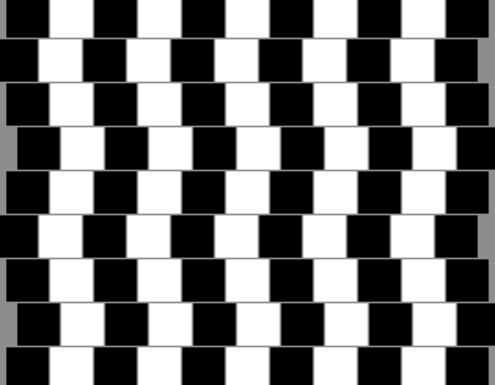
Are the lines straight or slanted?
Obviously at first glance, your mind is telling you that the lines are slanted. But after a close examination, you could probably tell that the lines are actually straight. This is a perfect example of your perception decieving you. I would love to say that perception is better and more important as a source of knowledge than reason, and I do believe that to a certain extent, however I realize that your perception can be false. Before our tok class I would have easily argued how great your perception is, however after all the optical illusions, I am not so sure. I still believe that you need to percieve something before you can use your reason to rationalize it, however without your reason, you would believe false things. If I didn't reason that the lines are actually straight, I would have believed that they were slanted, because that is what my perception told me. So which is really better? I think you need both to work together or it will be nearly impossible to gain true knowledge.
Sunday, October 25, 2009
Language vs. Thought
A question that came up in class one day was what comes first, a thought or a language? Can you have a thought without knowing a language? I definitely believe that yes, you can have a thought without knowing a languge. A child thinks before they can speak a language, although they also have understanding of a language before they can speak it. However, I think that you can have thoughts in the form of pictures rather than with words, you percieve things from the moment you are born, and from that time on, you must therefore have thoughts of the things you percieve. Though it may be difficult to convey your thought without a language, I don't think you need the language to have the thought. Certainly though, a language makes it easier to convey your thoughts to other people even though language can easily be misunderstood.
A thought must have come first because someone had to think up the very first language, even if it was pictures drawn on a cave, it was still a language. And from there, the languages grew and became the words that I am using right now. Language is a very useful tool though it is still easily misunderstood and there are many different forms of language and the definition of a language is not a sure thing, it is still a useful tool which resulted from a thought.
Now I'm not even sure if this made any scence to anyone other than me..But I hope so!
A thought must have come first because someone had to think up the very first language, even if it was pictures drawn on a cave, it was still a language. And from there, the languages grew and became the words that I am using right now. Language is a very useful tool though it is still easily misunderstood and there are many different forms of language and the definition of a language is not a sure thing, it is still a useful tool which resulted from a thought.
Now I'm not even sure if this made any scence to anyone other than me..But I hope so!
Subscribe to:
Comments (Atom)